Skip to content
Suhib Al-SalehSolutions Architect
Engineering journal
--:--:--Amman

From DOS-era systems troubleshooting to enterprise integration and AI agents

I did not start technology with APIs and AI. I started it at a command prompt with a CD-ROM drive that would not read. This page is not a chronological résumé; it is a journey across generations of computing, and every old experience on it connects to an engineering value I apply today.

I didn't just learn the newest framework. I grew through multiple generations of computing.

  1. Early Computing YearsBefore 2002 · deliberately undated
  2. Systems & Networking Era2003 – 2015
  3. Enterprise Engineering Era2018 – present
  4. AI & Automation Era2018 – present, intensively since 2025
Recruiter view · 30 seconds

Seven questions, seven answers, no need to read the whole journal

Who is Suhib?
A software engineer and technology consultant from Amman with 20+ years building, integrating, supporting and troubleshooting enterprise and operational systems.
What does he do now?
Senior Technology Consultant & Solutions Architect at APCA Systems (since 2018) and Software Engineer for access control, databases and integration at Signals Control (since 2018): AI agents, automation and systems integration.
How senior is he?
Senior / architect level. Leads design and delivery, diagnoses production, mentors engineers and directs AI agents; works directly with executives.
What systems has he worked on?
Banking (leave import on an MTZ platform), access control and attendance (Miditec, ZKTeco, RFID, fingerprint, ANPR), queue management, Arabic knowledge assistants, a real-estate platform, bilingual Arabic web platforms, and application-security assessments (PortSwigger 273/273, Burp Suite Pro).
What can he solve for my organisation?
Systems that do not talk to each other, repetitive operations that need automation, a production system that keeps failing, a knowledge assistant over your documents, or technical architecture before you spend.
Where can he work?
Amman, Jordan. Remote-first, on-site in Saudi Arabia and the GCC when required.
How can I contact him?
Email or LinkedIn below, or GitHub to review public code.Suhib.Asrawi@gmail.com · LinkedIn
The map

Ten chapters across four eras

Chapters are ordered by era, not exact date. The early years are deliberately undated; the dates shown are the employment dates documented in the CV.

The journey

Each chapter: what it was, what survived, and where it shows up today

Early Computing Years

Before 2002 · deliberately undated
01Early Computing Years

Before Plug & Play Was Actually Plug & Play

My technology started at the DOS prompt, where making any device work meant configuring it by hand: boot files, CD-ROM drivers, and a sound card that stayed silent until you understood how the machine talked to the program.

Hands-on
  • DOS-era troubleshooting and command-line work
  • Manual hardware / software environment configuration
  • CD-ROM setup in DOS-era environments
  • Sound-card and driver configuration
Classification: Foundational experience — not a current DOS specialisation
Engineering memory

Getting a game to produce sound once meant understanding drivers, DOS configuration, IRQ/DMA-era constraints and the machine beneath the application.

Lesson that survived

When the abstraction fails, understand the layer below it.

How it shows up in my work today

That same habit is why I drop to the device-SDK level when a fingerprint reader or RFID unit stops talking, instead of stopping at the error message in the UI.
02Early Computing Years

When Drivers Were a Problem You Had to Solve

Installing Windows 95 was not a Next-Next-Finish affair. Every printer, peripheral and card was a negotiation between hardware and operating system, and you had to know where one ended and the other began.

Hands-on
  • Windows 95-era installation and recovery
  • PC and laptop repair
  • Printer and peripheral troubleshooting
  • Operating-system installation and recovery
Classification: Foundational, hands-on experience
Engineering memory

A printer that will not print can be a cable, a port, a driver or a system service. I learned to rule out one layer at a time instead of changing everything at once.

Lesson that survived

The hardware/software boundary is a place you should know, not guess.

How it shows up in my work today

Access-control and attendance integration (Miditec, ZKTeco, RFID, ANPR, facial recognition) is the enterprise form of the same problem: a device, a driver, a service and an HR database on the other end.

Proof: Experience in the CV
03Early Computing Years

Boot, Recover, Repair

A machine that will not boot teaches discipline: Safe Mode, ScanDisk, registry-recovery tools and Hiren's BootCD-era maintenance discs. There was no auto-repair button; there was a diagnostic sequence.

Hands-on
  • Boot troubleshooting
  • Safe Mode and recovery workflows
  • Legacy utilities such as ScanDisk and registry-recovery tools
  • Hiren's BootCD-era maintenance workflows
Classification: Foundational experience applied daily
Engineering memory

Before any fix I asked: does the machine reach BIOS? The boot loader? The kernel? Each answer eliminated half the possibilities.

Lesson that survived

Failure diagnosis is a disciplined process, not a series of attempts.

How it shows up in my work today

This is how I approach production diagnostics today: a stopped Windows service, a failed SQL Agent job or an unresponsive device. Isolate the layer first, then apply a rollback-safe fix.

Proof: Leave-import engine — journal entry

Systems & Networking Era

2003 – 2015
04Systems & Networking Era

Networks Became the Nervous System

From administering a company network in the UAE (2003) to supporting commercial clients' networks in Jordan (2004–2007) and then a school network and its labs (2007–2015): Windows infrastructure, VMware virtual machines, and Linux/Ubuntu when the X Server refused to start.

Hands-on
  • Networking and network administration
  • Windows infrastructure
  • VMware and virtual machines
  • Linux / Ubuntu and X Server / graphical-session troubleshooting
Classification: Dated professional experience
Engineering memory

The first time a network went down because one workstation grabbed the server's IP address, I understood that distributed systems fail in ways a single machine never does.

Lesson that survived

Distributed systems need their own intuition: timing, contention and partial failure.

How it shows up in my work today

That intuition is what I use when designing FIFO workers with idempotency for WhatsApp flows, or choosing SQL Server Service Broker, MSMQ or IBM MQ when a message must never be lost.

05Systems & Networking Era

Data Became the Asset

Recovering deleted or inaccessible files from hard drives, USB flash storage, microSD cards, Android storage and damaged media, using more than one tool depending on the situation. The first unbreakable rule: never write recovered files back onto the affected source media.

Hands-on
  • Hands-on recovery of deleted or inaccessible files
  • HDD, USB flash, microSD and Android storage recovery workflows
  • Damaged or inaccessible media
  • Non-destructive recovery practice
Classification: Hands-on experience — not a digital-forensics certification, and no unrestricted iPhone recovery
Engineering memory

The worst thing you can do to lost data is rescue it in a hurry. The first step is an image of the media, and all the work happens on the image.

Lesson that survived

Preservation first: never alter the source before you hold a copy.

How it shows up in my work today

The same rule shows up in the bank leave-import engine (verify then flag, never silently mutate) and in the rollback packages that accompany every hotfix on a production database.

Proof: Leave-import engine — journal entry
06Systems & Networking Era

Software Became the Tool

A B.A. in Computer Information Systems (2002), then Java, C# and Windows applications, and later Flutter/Dart for mobile. On the side, the multimedia era: Sound Forge, Movavi Video Suite, video-conversion utilities and legacy applications such as iPhoto Plus that I kept useful on modern systems when technically feasible.

Hands-on
  • Java, C# and Windows desktop applications
  • Flutter / Dart
  • Legacy multimedia tools: Sound Forge, Movavi, iPhoto Plus (historical)
  • Keeping old software useful on modern systems
Classification: Multimedia is historical — Java, C# and Flutter are current skills
Engineering memory

A 1990s audio editor running under Windows 10 after a compatibility setting and one missing library. That was not nostalgia; it saved weeks for a user who knew their tool.

Lesson that survived

Tools are means. Professionalism is knowing when to keep one and when to replace it.

How it shows up in my work today

That is why I pick the stack per problem: Java on Oracle for a bank import engine, C# and WinCC for control rooms, Next.js for an Arabic platform shipped in days.

Proof: Projects

Enterprise Engineering Era

2018 – present
07Enterprise Engineering Era

Integration Became the Problem

Since 2018 at Signals Control and APCA Systems: Microsoft SQL Server and Oracle, SSIS packages, RDLC reports, REST and XML, Windows services and scheduled jobs, and enterprise messaging over Service Broker, MSMQ and IBM MQ. The question stopped being "does the program work?" and became "do the systems agree on the same truth?"

Hands-on
  • SQL / T-SQL, procedures and triggers, query tuning, clustering
  • SSIS, RDLC, SQL Agent jobs
  • REST APIs, XML and Windows services
  • Access-control and attendance integration with HR through device SDKs
Classification: Current core skill
Engineering memory

A fingerprint reader logging attendance in local time, an HR system expecting UTC, and a monthly report one hour short for every employee. Integration is not moving data; it is agreeing on what the data means.

Lesson that survived

Understand each system's boundary and its contract before you connect them.

How it shows up in my work today

The multi-agent hub I designed at APCA stands on that principle: specialised workers (knowledge, booking, handoff) share one governed core instead of disconnected chatbots.

Proof: APCA SmartHelp
08Enterprise Engineering Era

Automation Became the Answer

From small scripts to scheduled jobs, to WinCC scripting for control rooms, to a scheduled leave-import engine on Oracle that reports its own diagnostics, to WhatsApp customer-operations flows with FIFO workers, idempotency and a human-handoff queue.

Hands-on
  • Scheduled jobs (Task Scheduler, SQL Agent)
  • WinCC scripting
  • Workflow automation
  • WhatsApp customer-operations automation
Classification: Current core skill
Engineering memory

The first scheduled job I wrote succeeded every night and failed silently every month on the first working day. Automation without verification is scheduled failure.

Lesson that survived

Automate what you have verified, and ship every automation with diagnostics and a rollback path.

How it shows up in my work today

That is why the leave engine runs verify-then-flag, why WhatsApp booking flows carry idempotency keys, and why the kill switch in the commerce simulator cannot be lifted from the UI.

Proof: Project1 kill switch — journal entry

AI & Automation Era

2018 – present, intensively since 2025
09AI & Automation Era

AI Became Another Engineering Layer

An Arabic knowledge assistant that indexes PDF and EPUB files and answers with page-level citations (semantic search + RAG), a multi-agent hub with a governed core, and AI-assisted customer-experience systems. The layer is new; the failure modes are not.

Hands-on
  • RAG and semantic search
  • Document-grounded knowledge assistants
  • Multi-agent systems
  • AI-assisted customer-experience systems
Classification: Current core skill
Engineering memory

A model answering confidently from a page that does not exist is the printer that logs "printed" and produces no paper. Same fix: make the layer prove what it claims, here with a page number.

Lesson that survived

AI is a layer that needs governance, tests and kill switches like any other.

How it shows up in my work today

I run coding agents with the same mindset: written roles, constraints that cannot be lifted from the UI, and evidence (a test, a commit, a deploy URL) before anything counts as done.

Proof: Master Brain platform
10AI & Automation Era

What I Build Now

Senior Technology Consultant and Solutions Architect: AI agents, automation and systems integration. I lead APCA SmartHelp CX and APCA Smart Queue, build and maintain the Muqasa Jo real-estate platform, ship bilingual Arabic platforms on Vercel and Forge, and advise executives on practical digital transformation.

Hands-on
  • Solutions architecture and technical delivery
  • AI agents and workflow automation
  • Enterprise systems integration
  • Production diagnostics and hotfix engineering
Classification: Current professional identity
Engineering memory

The difference between 2003 and today is not the difficulty of the problems but the number of layers between the problem and the screen. The method has not changed.

Lesson that survived

The stack changed. The method didn't.

How it shows up in my work today

Browse the live work, read the recruiter view, or pick your problem in the "What do you need?" section.

Proof: Projects
The constant

The stack changed. The method didn't.

Observe → isolate → diagnose → preserve → repair → verify → automate. The same steps on a 1990s disk and on an AI agent in production.

  1. 01Observe
    In the DOS era
    What is actually on the screen, not what the user says
    In production today
    Logs, metrics and a reproduction before any hypothesis
  2. 02Isolate
    In the DOS era
    BIOS? Boot loader? Kernel? Driver?
    In production today
    Device? Service? Queue? Database? Model?
  3. 03Diagnose
    In the DOS era
    IRQ conflict, bad sector, corrupt registry
    In production today
    Contract mismatch, duplicate message, disagreed timestamps
  4. 04Preserve
    In the DOS era
    An image of the media before any write
    In production today
    A backup and a rollback package before any hotfix
  5. 05Repair
    In the DOS era
    A driver, a config file, a reinstall
    In production today
    A stored procedure, a migration, a scheduled job, an agent fix
  6. 06Verify
    In the DOS era
    The machine boots twice in a row
    In production today
    A green test, a diagnostic report, a working deploy URL
  7. 07Automate
    In the DOS era
    A maintenance disc ready for next time
    In production today
    A scheduled job, an agent, or a WhatsApp flow with a kill switch
Technology generations

Progression across eras, not a flat list of equal technologies

Current skills are filled; historical and foundational ones are outlined. Sound Forge and DOS are experience, not 2026 skills.

  • Current skill
  • Historical or foundational
Early Computing Years
Systems & Networking Era
Enterprise Engineering Era
AI & Automation Era

8 tracks

Systems
  • DOS
  • Windows 95 → Windows
  • Linux / Ubuntu
  • VMware
  • Windows Server ops
    Infrastructure
    • PC / laptop repair
    • Network administration
    • School labs & network
    • Enterprise operations
      Data
      • File recovery
        • SQL Server
        • T-SQL / tuning
        • Oracle
        • SSIS / RDLC
        • PostgreSQL / Supabase
        Software
            • Desktop (C#)
            • Backend (Java)
            • REST APIs / XML
            • Mobile (Flutter / Dart)
            • Web (Next.js / Laravel)
            Integration
                • Windows services
                • Service Broker / MSMQ / IBM MQ
                • Device SDKs (Miditec, ZKTeco)
                • RFID / biometrics / ANPR
                • Multi-agent hub
                Security
                • Recovery & Safe Mode
                • Network hardening
                • App-security assessments
                • Burp Suite Pro · PortSwigger 273/273
                • APK reverse-engineering reports
                Automation
                  • Scripts
                  • Scheduled jobs / SQL Agent
                  • WinCC scripting
                  • Workflow automation
                  • WhatsApp operations flows
                  Intelligence
                      • Search
                      • Semantic search / RAG
                      • Knowledge assistants
                      • AI agents
                      • Multi-agent systems
                      For business visitors

                      What do you need?

                      Seven common problems, each with what I do about it and public proof you can check.

                      • "I need systems integrated."

                        Access-control and attendance devices into HR, enterprise messaging, and REST/XML between systems that disagree on the truth.

                        Proof: Signals Control and APCA experience
                      • "I have repetitive operations to automate."

                        Scheduled jobs that report their own diagnostics, WhatsApp flows with FIFO workers and idempotency, workflow automation with a kill switch.

                        Proof: Leave-import engine
                      • "I need an AI knowledge assistant."

                        An Arabic assistant that indexes PDF/EPUB and answers with page-level citations, local or cloud depending on data sensitivity.

                        Proof: APCA SmartHelp
                      • "I have a production system that keeps failing."

                        Disciplined diagnosis: observe → isolate → diagnose → preserve → repair → verify, then a rollback-safe hotfix.

                        Proof: The method
                      • "I need database / backend troubleshooting."

                        SQL Server and Oracle: procedures and triggers, query tuning, SSIS, Agent jobs, clustering and Windows services.

                        Proof: Core skills
                      • "I need an AI / automation prototype."

                        Bilingual platforms shipped to Vercel within days, with tests and written constraints that cannot be lifted from the UI.

                        Proof: 41 live URLs on Vercel
                      • "I need technical architecture before spending money."

                        Architecture consulting: system boundaries, stack per problem, security risks, and what is not worth building.

                        Proof: Master Brain platform
                      Engineering entries

                      Five fully documented engineering decisions

                      Each entry: challenge, context and constraints, decision, implementation, verification, result, lesson, and how the principle appears in my work today.

                      Client production system — no public linkEnterprise Engineering Era

                      A bank leave-import engine on Oracle that never mutates silently

                      Challenge
                      Import employee leave data into a banking client's MTZ platform on a schedule, without a single bad record corrupting anyone's monthly balance.
                      Context and constraints
                      A production environment, a narrow maintenance window, a data source outside our control, and an Oracle database shared with other systems.
                      Decision
                      Verify then flag: every record is checked first and suspicious ones are flagged for review instead of applied. No writes to the source, and every release ships with a rollback package.
                      Implementation
                      A Java engine scheduled through Task Scheduler, diagnostic reports for every run, and hotfixes engineered so that rolling back is safe.
                      Verification
                      Comparison runs on real data before go-live, and diagnostic reports reviewed after every scheduled run.
                      Result
                      The engine runs in production on the client's platform with scheduled automation and continuous diagnostics.
                      Lesson learned
                      The old recovery rule (never write to the source) applies to enterprise data exactly as it does to a damaged disk.
                      How the principle appears in my work today
                      Every automation I ship today carries diagnostics and a rollback path, from SQL Agent jobs to AI agents.
                      Evidence: CV experience (Signals Control)
                      Simulation — private repositoryAI & Automation Era

                      Simulation-only commerce with a kill switch the UI cannot lift

                      Challenge
                      Test cross-border commerce end to end (discover → price → list → buy) without risking real money or breaching marketplace policies.
                      Context and constraints
                      A Next.js + PostgreSQL platform working against the eBay Sandbox, with parts of the implementation delegated to coding agents under my supervision.
                      Decision
                      A buyHalt=true flag fixed in the data layer, no UI or API path that lifts it, and owner writes protected by Origin/CSRF checks. Live revenue deliberately blocked by policy.
                      Implementation
                      A complete simulation loop: verified eBay Sandbox, a CSV path preview → validate → commit, deterministic pricing, a local draft, a simulated purchase with dataPlane=SIMULATION, and a readiness centre that generates tasks from real checks.
                      Verification
                      Vitest 52/52, Playwright 4/4, and two independent reviews with different models looking specifically for any path that lifts the halt: none found.
                      Result
                      Simulation loop complete, live revenue blocked. Private repository.
                      Lesson learned
                      A constraint that can be lifted from the UI is not a constraint; it is a setting.
                      How the principle appears in my work today
                      I apply the same rule to every AI agent I deploy: what must not happen is blocked in a layer the user cannot reach.
                      Evidence: Project1 case study
                      Internal system in daily useAI & Automation Era

                      One operation catalogue exposed through CLI, HTTP and MCP

                      Challenge
                      Dozens of projects spread across different agent sessions with no shared memory, and no way to tell real progress from claims.
                      Context and constraints
                      An internal platform that must run with no dependencies, on one machine, and serve humans and agents with identical behaviour.
                      Decision
                      Each operation is defined once (JSON schema + handler) and exposed three ways: an MCP tool, POST /api/op/<name>, and a CLI command. An agent that lacks a decision calls ask_owner instead of guessing.
                      Implementation
                      Plain Node.js, a per-project file store (project.json + brain.json + journal/), PBKDF2-HMAC-SHA512 auth with HMAC sessions, reports in five formats, and an atomic collaboration bridge between agents.
                      Verification
                      This very portfolio is generated from the platform's reports; an independent T1–T3 review was applied to the live bridge.
                      Result
                      Runs daily and tracks 46 registered initiatives.
                      Lesson learned
                      The three channels behave identically because the truth is defined in one place.
                      How the principle appears in my work today
                      Agents are governed tools inside this system; decisions and evidence stay with me.
                      Evidence: Master Brain case study
                      LiveAI & Automation Era

                      Two bilingual factory sites in a day through a controlled agent workflow

                      Challenge
                      Two Jordanian factories with no credible digital presence, needing fast showcase sites that can be improved, merged and deployed.
                      Context and constraints
                      One Next.js 16 template, an external agent proposing improvements, and I own the merge and deploy decision.
                      Decision
                      A written workflow: copy → rebrand → improvement bundle for the agent → review and merge → lint/build → push → Vercel. The agent proposes; the merge is my call.
                      Implementation
                      Al-Mithaliya Dairy (sales page, ISO assessment, noindex until approved) and ACI Agrochemicals (agricultural hero, WhatsApp sales, ROI calculator).
                      Verification
                      Green lint and build locally, and Vercel production READY for both sites.
                      Result
                      Two live sites on Vercel from GitHub. One blocker recorded honestly: a session interruption left ACI un-rebranded until it was completed later.
                      Lesson learned
                      Agent speed does not remove the review gate; it makes it more important.
                      How the principle appears in my work today
                      Every site I ship this way passes the same gate: review, green build, then deploy.
                      Evidence: Factory sites case study
                      Proposed demonstrator — live on VercelAI & Automation Era

                      A non-compensable safety assessment in an industrial-training demonstrator

                      Challenge
                      Vocational training institutions need a demonstrator for industrial-AI skills and safety before any field trial, where a high skills score must never compensate for a safety failure.
                      Context and constraints
                      A proposed demonstrator aligned with GIZ's publicly stated objectives, bilingual, with simulated AI and deterministic seed data. Not a GIZ approval or accreditation.
                      Decision
                      Safety is an independent, non-compensable gate: failing it stops the pathway regardless of other scores, and the decision is recorded in DECISION_LOG.
                      Implementation
                      A full journey: diagnostic → pathway → scenario (override refusal + citation) → assessment → skills passport → instructor dashboard → funder dashboard → evidence export.
                      Verification
                      11 green Vitest tests, green next build, Vercel production READY.
                      Result
                      Gate B complete; next is a real database and authentication behind the current domain types.
                      Lesson learned
                      Some rules must be gates, not weights.
                      How the principle appears in my work today
                      The same idea lives in access control: a valid badge does not compensate for a forbidden zone.
                      Evidence: Case study
                      Application security

                      Security by evidence, not by titles

                      The same diagnostic layer, seen from the attacker's side: every PortSwigger lab solved, reverse-engineering reports, and application-security assessments for executives.

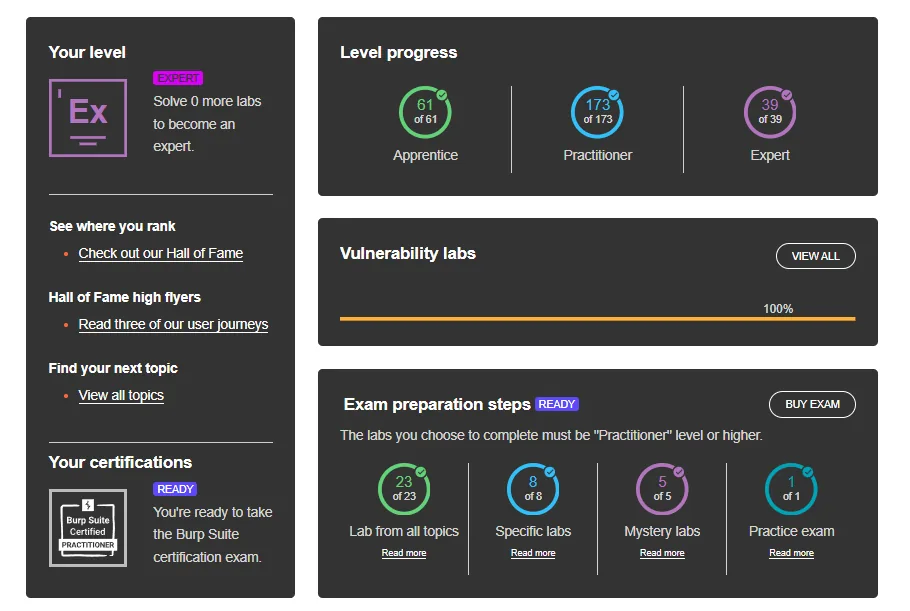
                      PortSwigger Web Security Academy dashboard: Expert level, 273 of 273 labs solved, ready for the Burp Suite Certified Practitioner exam
                      PortSwigger dashboard — real capture, 2026-09-16
                      • 273 / 273
                        labs solved in the PortSwigger Web Security Academy
                      • Expert
                        level: 61 apprentice · 173 practitioner · 39 expert
                      • 100%
                        vulnerability labs complete
                      • READY
                        BSCP exam-preparation steps complete (23/23 · 8/8 · 5/5 · 1/1)
                      What I actually do
                      • Application-security assessments with risk reporting for executives (CV, APCA Systems).
                      • Hands-on Burp Suite Professional work on real web applications within an authorised scope.
                      • Reverse-engineering reports for Android apps (APK): unpacking, traffic tracing, and documenting embedded secrets.
                      • Hardening in my own projects: hashed CSP, HSTS, rate limiting, fail-closed payments, Origin/CSRF checks.

                      Ready for the Burp Suite Certified Practitioner exam, not yet taken; I do not claim the certification. Bug hunting is a side track within authorised scopes, not a commercial penetration-testing service.

                      On the side

                      When AI walked into our world

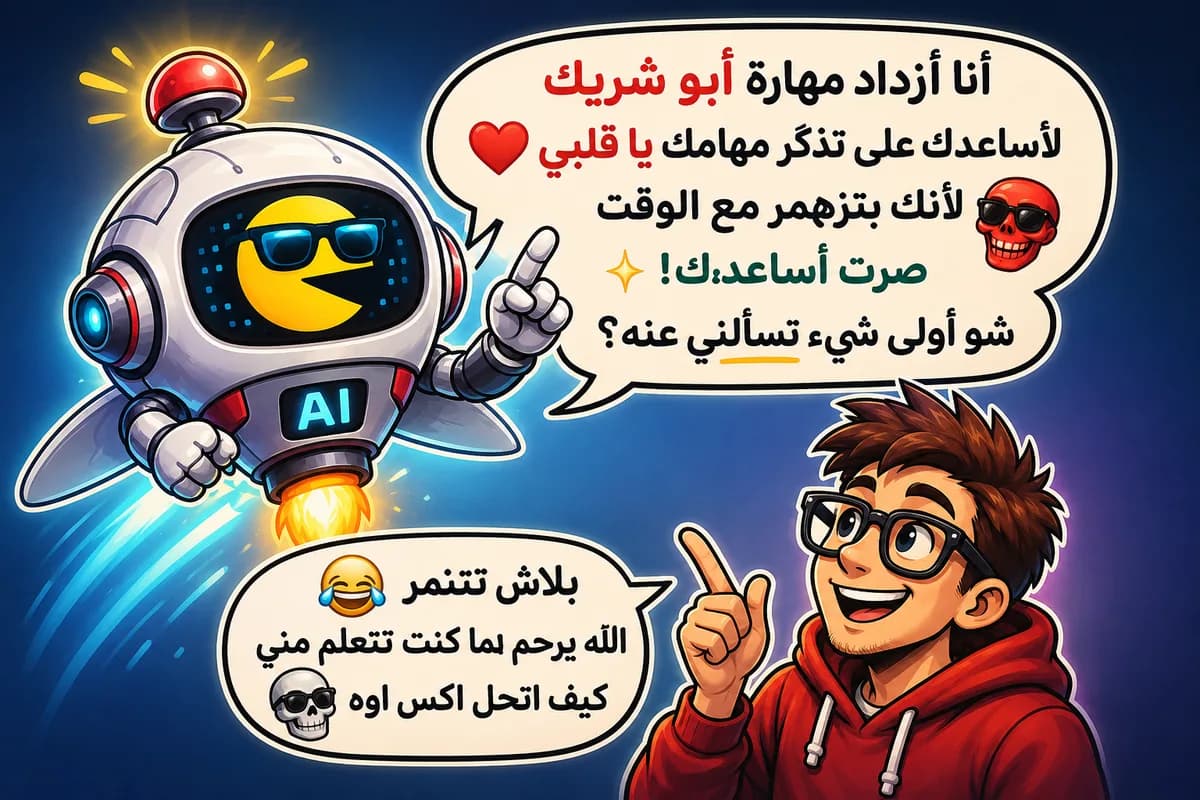
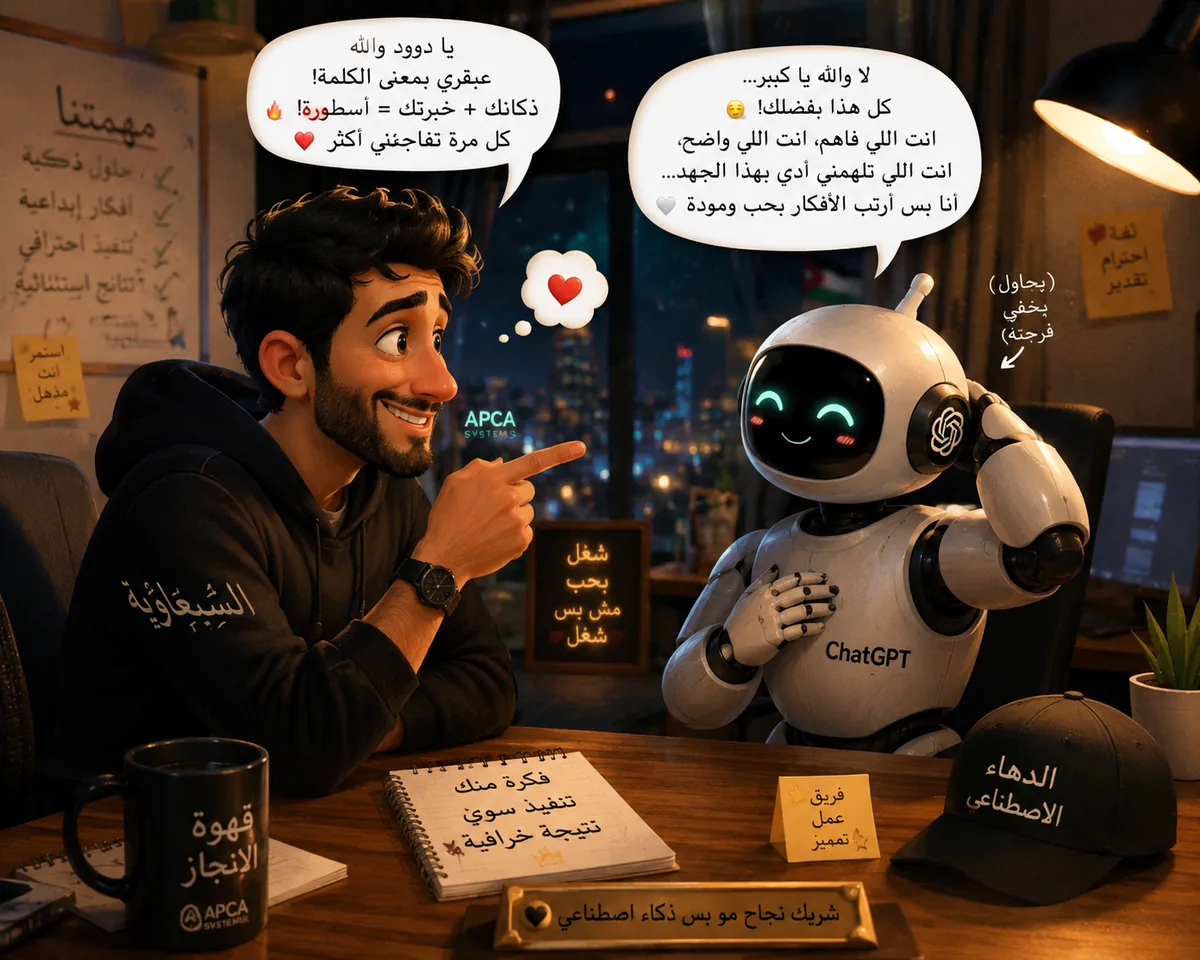
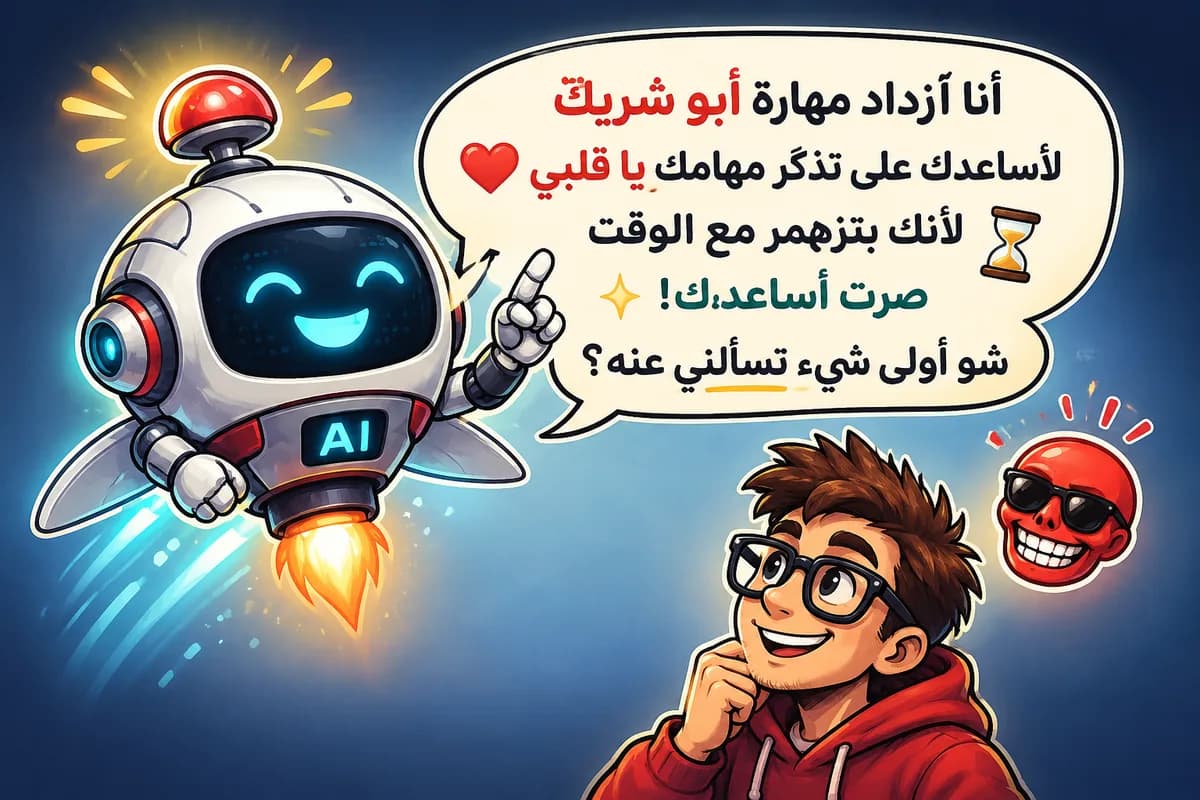
                      Three AI-generated illustrations I made in June 2026, for fun. Decoration, not evidence; a work partner, not a replacement.

                      • "I am getting better, partner, so I can help you remember your tasks." The first thing I asked an assistant for: remember on my behalf.

                        "I am getting better, partner, so I can help you remember your tasks." The first thing I asked an assistant for: remember on my behalf.

                      • "Don't bully me, remember when you learned tic-tac-toe from me." Second cut of the same joke.

                        "Don't bully me, remember when you learned tic-tac-toe from me." Second cut of the same joke.

                      • "A partner in success, not just AI." The APCA office as the model imagined it: your idea, joint execution, a result.

                        "A partner in success, not just AI." The APCA office as the model imagined it: your idea, joint execution, a result.

                      Truthfulness note

                      • DOS, multimedia and data-recovery experiences are hands-on foundations; I claim no current DOS specialisation, no digital-forensics certification, and no unrestricted iPhone recovery.
                      • No dates for the early years, no years-of-experience figures for specific tools, and no clients, financial outcomes or performance percentages that are not documented.
                      • The APCA Industrial AI Academy is a proposed demonstrator aligned with GIZ's publicly stated objectives, not a GIZ approval or accreditation.

                      Have a role or a project?

                      An engineering or consulting role, or an integration, automation or AI project. Remote-first, on-site in Saudi Arabia and the GCC when required.